Planning: Location

In all genres, location is very important but for the genre of horror it is particularly important and you could argue it is the one film genre that is it vital for the location to be spot on. For this reason it is important that we find a location suitable for us to film from to create a strong opening to our horror film. 

For the location planning, our group needed to decide what the most suitable location was to film our opening. After reviewing several different locations we decided that the kitchen worktop in the picture below was the most suitable location. This is the case as we needed a location that for starters was indoors. We needed it indoors because of the lighting, camera shots and angles etc. This location obviously ticks the box. Also, we needed somewhere that had a desk/unit allowing us to put all the props we are going to use on top of. This again adds to the suitability of the location as this location allowed us to do this. In addition, we needed a location that was dark and secluded to add a sense of mystery and suspension in our opening. Although the picture below looks quick bright this can be easily adjusted as the blinds in the room affect the light levels coming into the room to the extent you want. Furthermore, there is plenty of space around the desk (where the picture is being taken from) which was again something that was important to the filming of our opening. This was important as this space allowed us to affect many different factors such as camera shots and angles and therefore meant we had more potential to create a good opening. 


Overall, when you consider the requirements of the location we wanted and what we actually have to work with, you have to conclude that this location has the potential the create a good opening. This is the case as explained above, it is extremely suitable as it has everything we want such as a unit to put the props on, the ability to make it dark and secluded to create mystery etc. 

Planning: Mise En Scene

The term 'mise en scene' is a french term that translates roughly into 'put into the scene'. Some examples of mise en scene include costumes, make up, props etc. Here below are some examples of the mise en scene that was included in our film opening;
This is a Stanley knife. This will be used several
times in the opening to perform tasks such as
cutting through the pages and slicing up pictures
of victims. The use of this suggests that the killer
is very precise and particular in what he does. The
fact it's a knife also obviously indicates danger and
brutality.


This is a stapler. This isn't used in the
opening but is present on the desk of the
killer. The presence of this object again shows
the organisation of the character as it allowed
the papers to be organised and therefore the
character could refer back to important
 information easily.  
This is a pen. This is used on several different
occasions during the opening where the psychiatric
makes notes with the pen, twiddles the pen in between his
thumbs etc. this suggests the killer pays a lot of attention to
detail and the camera will be focused on the hands with the
pen in it to create a sense of mystery and enigma. 

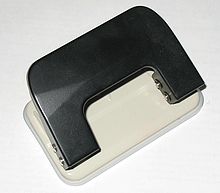
This is a hole punch. This will be used to hole
punch the paper that the killer had made notes
on. The aggressive way in which they use this
tells us they have a vicious side to their character.
Also, the use of this object shows that the killer is
very organised and he orders the papers, straightens
them and uses the hole punch. This shows organisation
and that they are a meticulous planner. 

Planning: Casting

After completing the treatment, screenplay and storyboard it came to doing the cast for our film opening. We knew from this previous planning that the only casting required for our film opening is a pair of hands. The was only several criteria we needed to follow regarding the pair of hands required for the film opening. We wanted a pair of males hands as the character in our film is going to be a psychiatric and therefore we felt it would be more suitable to use a pair of male hands for the filming. Also, we wanted the fingers to be quite long for several. Firstly, it fits the stereotype of all medical professions such as doctors, dentists etc. that all males in a medical profession have fairly long thin and long fingers. Also, we believe these characteristics create a sense of creepiness and enigma. In addition, if we were to use short, stubby hands we believe it wouldn't be able to create any sense of eeriness. In the end we used the hands of one of our group members. We believe that the hands shown below fit the characteristics we were looking for in order to film the opening;

Planning: Storyboard

Creating a storyboard is useful and is an important stage of planning. It is both useful and important because it gives you a good idea of what the film opening is going to be allowing you to assess the strengths and weaknesses and therefore make improvements should they be required. It gives you a good understanding of what is going to be achieved and it gives you something to build upon. Here below is the storyboard for our film opening;


You can see that our storyboard has good detail which was very useful to our group as it gives us a very accurate idea of what our film opening is going to be like. Also, it makes it much easier for the planning of other things such as the casting, location and mise en scene. This is the case as all the information required to carry out these planning stages is included in the storyboard. Furthermore, it also gave a rough idea of the camera angles/shots/movements etc. that will be used when we come to film and therefore it becomes a very useful tool to refer back to when we come to do the filming for the opening. 


Planning: Screenplay

*Psychiatrist*

by 


Liam Wood and Scott Hackett

Fade in:

Title - 'BROADMOOR FILMS PRESENTS'
This is in a white, scratchy font in front of a book background with it all in capital letters. 

Goes to a dead  cut with a black screen.
Title 2 appears in bottom right hand corner in white, scratchy font.

After various other shots a black screen appears with the name of the 2nd actor in a white, scratchy font.

Close up of notes being written in a book showing another actor title which again is in a white, scratchy font.

Camera shot - extreme close up
Shows hands cutting up photos of victims (victim 2)

Close up of blood being smothered over the page. Blood is red (obviously) on top of the pages which are white.

Dead cut. Goes to the whole face being crossed out (victim 1)

Close up of photos being aligned on the page. Screen has a red filter. The title is again in a white, scratchy font stating 'music by…'

Close up of a photo been stuck down onto the page which is being rubbed over by the palm of a hand.

Camera shot - Mid shot
Panning shot of filing cabinet with the title stating 'written by…'. The title is again in a white, scratchy font.

Close up shot of the main characters hand shuffling the papers together, banging them on the table to line them up and then laying them back down.

The screenplay is finished with a black screen with a title saying 'directed by…'. This title is again in white, scrathy font.


Planning : Treatment

The film opening starts with a clip of a book opening up, where the fist title appears in the bottom right hand corner. There is then a dead cut to a black screen where we have title 2 in the top right hand conner of the screen. We then have a dead cut to a hand turning a page of a book with title three appearing at the bottom of the screen. We then have a close up of a blunt object, or the weapon that the psychiatrist uses with the camera panning across, then a cut to a black screen with title five appearing on the left hand side of the screen. We will have a dead cut to a black screen where we will have the main actors name in the center of the screen in rather larger writin than the previous texts. we then have an extreme close up of the index finger and thumb rolling a pen inbetween. There is then a cut to a black screen and the mane of our second actor appears in the centre of the screen. We then have a cut to a clip of the psychiatrists cutting up of newspaper titles linked to the killings, the screen then cuts to black where the film title appears in the middle of the screen, slightly off centre in larger writing than all other texts. The cut then goes to a hand grabbing a closed book off of a table with a few sheets of paper scattered. This is also cross-cut or over-lapped with a clip of pages being turned. This cross-cut is then changed into just the clip of pages turning with another actors name appearing. We then see a man writing notes in a book when the name of another actor pops up in the corner. The man writing his notes is then overlapped with a a still picture of some notes that have been made prior. There is a cut to a black screen with the name of another actor that stars in the film. There is then a cut the actor cutting up photos of the victims that have been killed after they have died. Another black screen and another actors name appears on the screen. We then see the actor cutting out pictures of his victim when they were alive then the cut again, goes to a blckscreen ander an actors name comes up. The cut then goes to the psychiatrist cutting up more photos of the victims when they've been murdered and then we see him slide them onto the page from a different angle. There is then a page of notes that has blood splattered over it and the actor runs his hand over the page. There is then a close up of the psychiatrist writing notes with a couple of layers of hands over lapping just off centre. There is a black scrren for the majority of the scree but then a spotlight towards the top right hand side where we can see a picture of one of the victims. Here we can see the title of who did the casting for the film. In the spot light we can see the psychiatrist get a marker pen and draw a line through the eyes of the victim. Then a dead cut to the same screen set up but with the whole face already crossed out and witht he man just drawing the last line; then we have a cut to an extreme close up of the pentip writing notes. The psychiatrist then aligns the pictures onto the page with a red filter over the whole screen, the title of 'music by...' then comes onto the screen. We then have the killer sticking the pictures down onto the page from a height and we have a dead cut to a black screen with the title of 'Edited By...' and then a cut to the psychiatrist rubbing his hand over the picture that has just been stuck down in the previous clip. There is another dead cut of the psychiatrist picking up a pile of notes that are on the desk, then a fading in cut of the book being turned with the pictures of the victims on it. There's a cut to a black screen with the title of 'Director of Photography' appearing in the centre of the screen. There is then a clip of the psychiatrist holding a pen in the writing position in the air. Another black screen is shown with the title of 'Executives Producers'. There is then a pan of a filing cabinet where the lighting is quite dim, and the title of 'written by' comes onto screen. A cut to the killers hands shuffling papers together, tapping the bottom onto the table and then laying them down. A black screen once again appears with the title 'produced by' comes onto the screen, there is another pan of a filing cabinet but with brighter lighting and the final dead cut is to a final brack screen with the directors name on again.

Planning: Possible Film Openings

As a group we have come up with two possible film openings. The reason we have done this is so that we can see what type of opening our target audience will enjoy the most. The aim is to present a group of people with these opening and get their opinion on which they prefer. When this has been done we will have a better idea of what will make our film opening a success. The possible openings are as follows;

Film Opening One
  • Who: The Psychiatrist that will appear in the film as the main character and villain, and one patient that he choses as one of his victims.
  • When: At the middle of the day, in a meeting between the two characters. The victim is a patient of the Psychiatrist so visits him often.
  • Where: The two characters are sitting in the Psychiatrists office having one of their regular meetings, the patient is sitting on a sofa with his/her back facing the door with the Psychiatrist sat opposite.
  • What: The Psychiatrist is asking the patient questions and recording the answers. After a while, the Psychiatrist excuses himself and walks out of the room. When he goes outside, he picks up a blunt object and takes his shows off at the door to avoid being heard. The Psychiatrist then walks back into the room, stands behind the patient and lifts the weapon - as he brings down the weapon and just before it makes contact with patient the scene cuts to titles.
Film Opening Two
  • Who: The Psychiatrist will briefly appear in the opening, but just the character writing in a book or notepad, so the face of the character may not be included due to a lack of importance of any story.
  • When: There is no time or date for this opening as it is an opening with no story, but based on the opening titles, like in Se7en.
  • Where: Again, there is no story line in this opening so there is no location for the opening, however when the psychiatrist is briefly shown, it will imply that he is in his office even if the filming doesn't take place there.
  • What: Like in the opening to Se7en, the opening will be wholly based on the opening titles. The structure of the opening will be a selection of clips of the psychiatrist writing, blood splatters across a page, glimpses of the psychiatrists head collection etc.

Target Audience Feedback


We got some feedback from our target audience about our potential openings. We showed two potential film openings to three people who we believed fitted our target audience and asked them for which opening they preferred and why. The feedback we got from these people was very important in helping us to decide which film opening was better to use.

Research: The Importance of Sound in Horror Films

Sound in horror films plays a massive part in making the film scary, making the film a horror. There is wide range of music used in horror films from your slow, high pitched music to create eeriness to your fast paced, low pitched music to create an immediate sense of danger and threat. Sound in horror has the ability and power to create a sense of danger and vulnerability just from an every day activity such as opening a door to a room. During a horror film, there are many different factors which affect the type of sound that is used. For example, in a blood and guts film such as jaws you would expect to hear a faster paced, low pitch sound accompanying the visual while with a film such as children of the corn you would expect a slower paced, high pitched sound to be used to create the tension.

The purpose of sound in horror films is to create a certain atmosphere which allows the audience to connect with the film more deeply and emotionally. It also enhances the overall quality of the film. For example, I watched a horror film trailer without any sound in it and it completely took alll the horror film feel away from it and lost the films sense of purpose.

Doing some research I found that the sound used in the majority of horror films, no matter how disimilar they may sound, plays on the instinctive fears of people. This means no matter of how fearless the audience may be, deep down there will be a sense of anxiety from each and every person watching the film. The class of noises used have been labelled as 'non-linear' sounds.

Psycho, arguably the most iconic horror film of all time, uses sounds extremely affectively and the sound used in the film is almost as big as the film itself. The sound in psycho became so iconic by how it amazingly ties in with the story of the film. An example of how effective sound is in this film is the use of the famous shrieking, staccato violin in the shower scene. This sound massively enhances the scene with the stabbing violin in compliment to the assailant's attack with a knife.

Here below in the video are examples of the sound used in some of the most iconic horror films of all time.


The Importance Of Opening Titles


The information you may be given during the opening titles of a film;
  • The title of the film
  • Cast in the film
  • The production company
  • The distributor company
  • Director, producer, make-up, costume design, music
What is the difference between opening titles and closing credits?
 
The difference between opening titles and closing titles is the following; the opening titles are there to inform the audience of the people who played the more important roles in the film. This will include those such as the director, producer and the production company. On the other hand, the closing credits list everyone who was involved in the film making; from the director and cast to the costume design and music department. During the opening titles it displays the theme including font, colour and style. These have all a correlation with the genre of the film.

What is the importance of opening titles?

The opening titles of a film are very important in giving the audience a lot of information. For example, it states the most important people in the film to give the audience that information. The names are usually given in the order of importance with the most important coming first. An example of this is from the film 'Se7en' where Brad Pitt's name is the first one stated out of all the actors. This is because he is the most well known actor in the film and the star actor therefore coming first in the titles. Also, he would be first in the titles as he of the biggest actors in the world and a huge star in Hollywood, therefore by putting him first this will attract viewers to the film. There are other crew members mentioned in the opening titles too. These include the director, producer and executive producer, music and the distributors. It is also important to include these members for the same reason that they are capable of attracting possible viewers. For example, the director of the 'Se7en', David Fincher, is a very successful and well known and respected director. This means people who have previously recognised his stuff and enjoyed it are likely to watch 'Se7en' due to the fact he is involved heavily in the making of the film. Opening titles aren't only just useful for giving the audience information, it has symbolic coding which the audience can recognise. For example, in 'Se7en', the font and style of the credits, along with the the music and image used all contribute to the genre. It is easy to make out from the titles that the genre of 'Se7en' is thriller.